
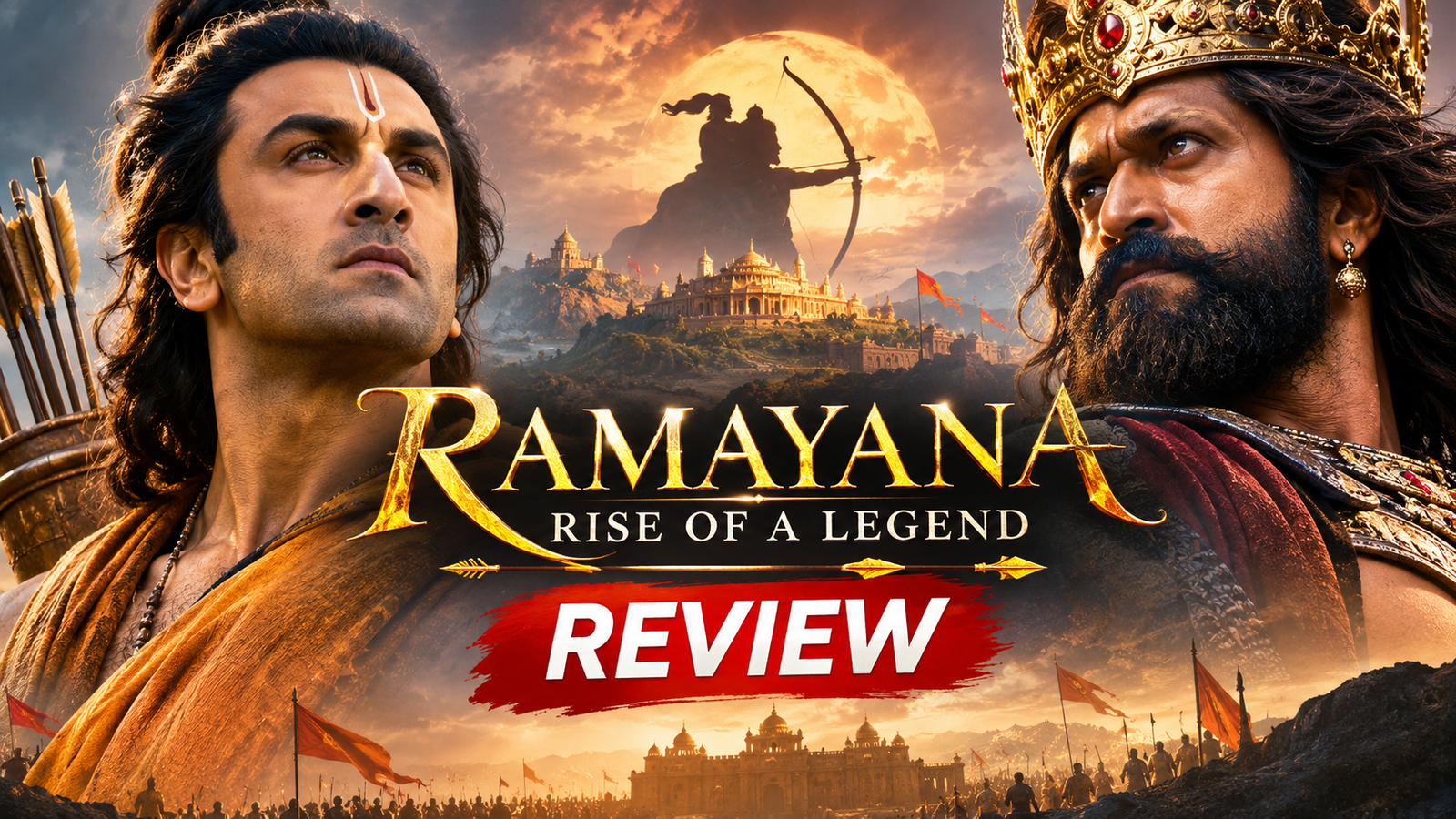
Few Indian stories carry the cultural significance and emotional connect of the Ramayana. Taking such an iconic tale to the big screen comes with enormous expectations. Director Nitesh Tiwari takes on this challenge with Ramayana: Rise of a Legend, an ambitious production designed to offer audiences a grand cinematic experience.
The film features Ranbir Kapoor as Lord Rama, Sai Pallavi as Sita, Yash as Ravana and Ravie Dubey as Lakshman. It follows the events surrounding Rama’s exile, his life in the forest, Sita’s abduction and the developments that lead to his eventual confrontation with Ravana.
The scale is undoubtedly impressive. However, the film’s biggest test is whether its storytelling matches the visual ambition.
The Performances Give the Story Its Emotional Core
Ranbir Kapoor takes a relatively restrained approach to playing Lord Rama. Rather than relying on dramatic expressions, he uses composure and subtle emotions to establish the character. His portrayal works particularly well in moments that demand patience, compassion and inner strength.
Sai Pallavi brings sincerity and grace to Sita. Ravie Dubey also makes his presence felt as Lakshman, adding warmth and conviction to the relationship between the brothers.
The emotional portions are among the film’s most effective moments. Rama’s departure from Ayodhya, his separation from Dashrath and the bond he shares with Sita provide a welcome balance to the action-heavy portions.
The production design deserves appreciation, too. The grandeur of Ayodhya, the imposing world of Lanka and the detailed costumes help establish the film’s setting. Hans Zimmer and A. R. Rahman’s musical contribution further strengthens several dramatic moments.
Yash Brings a Menacing Edge to Ravana
If there is one performance that generates considerable excitement, it is Yash’s portrayal of Ravana. The actor brings authority, aggression and an imposing screen presence to the character.
His appearance and intense expressions make Ravana a powerful adversary. The character is not simply presented as a villain who relies on physical strength. His pride, ambition and commanding personality add another dimension to the conflict.
The encounter between Ravana and Jatayu is a major action highlight. The high-octane sequence features spectacular combat while retaining the emotional significance of Jatayu’s attempt to save Sita. His courage and sacrifice make the confrontation more than just another action set piece.
Yash’s performance also raises expectations for the next chapter, particularly the much-awaited face-off between Rama and Ravana.
Spectacle Does Not Always Translate Into Seamless Storytelling
The film’s technical ambition is evident, but certain visual effects may leave viewers underwhelmed. Some CGI-heavy characters and creatures do not blend convincingly with their surroundings. Khar-Dushan and Kumbhkaran are among the examples where the artificial appearance of the effects becomes noticeable.
This inconsistency is disappointing in a production that otherwise invests heavily in visual detail.
The screenplay has its own challenges. The narrative occasionally loses momentum, with some portions feeling unnecessarily stretched. At other points, important developments could have benefited from greater emotional depth.
The film also has opportunities to explore the philosophical and spiritual dimensions of the Ramayana more effectively. Its focus on large-scale action sometimes comes at the expense of the deeper questions surrounding duty, righteousness, sacrifice and relationships.
Consequently, audiences looking for an equally strong combination of storytelling and spectacle may have mixed feelings.
Sunny Deol’s Hanuman Introduction Is a Major Post-Credit Highlight
Just when the film reaches its conclusion, the post-credit sequence offers an exciting glimpse of what lies ahead.
The sequence begins with Hanuman running through a dense forest. His gigantic figure creates an imposing visual. The introduction then moves towards its defining moment. Hanuman reaches a mountain, takes a massive leap into the ocean. The scale of the visual and the dramatic presentation make this one of the most exciting closing moments.
Sunny Deol’s face is deliberately kept hidden. However, his powerful voice can be heard chanting “Jai Shri Ram”, hinting at his portrayal of Lord Hanuman in the sequel.
The devotional element adds another layer to the sequence. The Hanuman Chalisa plays in the background, featuring the voices of Sukhwinder Singh, Shankar Mahadevan, Kailash Kher, Mohit Chauhan and Diljit Dosanjh. AR Rahman has composed the music for the recitation.
The combination of the forest sequence, Hanuman’s enormous leaps, devotional music and Sunny Deol’s commanding voice creates an effective build-up. Even without revealing his face, the film manages to generate considerable curiosity about his full-fledged appearance.
An Ambitious First Chapter That Leaves You Wanting More
Ramayana: Rise of a Legend has enough memorable moments to hold the attention of audiences. Ranbir Kapoor’s composed performance, Sai Pallavi’s grace, Yash’s commanding Ravana and the Ravana-Jatayu battle are among its strongest elements.
The post-credit sequence featuring Hanuman is another major talking point. Sunny Deol’s voice-only introduction, accompanied by the Hanuman Chalisa, provides an effective bridge to the next instalment.
However, inconsistent CGI, uneven pacing and certain narrative shortcomings stop the film from becoming a completely satisfying experience.
It is a film that deserves appreciation for its scale and ambition, but its execution does not always match its vision. For the audience invested in the Ramayana and its characters, there are plenty of moments worth watching. However, those expecting a flawless cinematic adaptation may find a few reasons to be disappointed.