

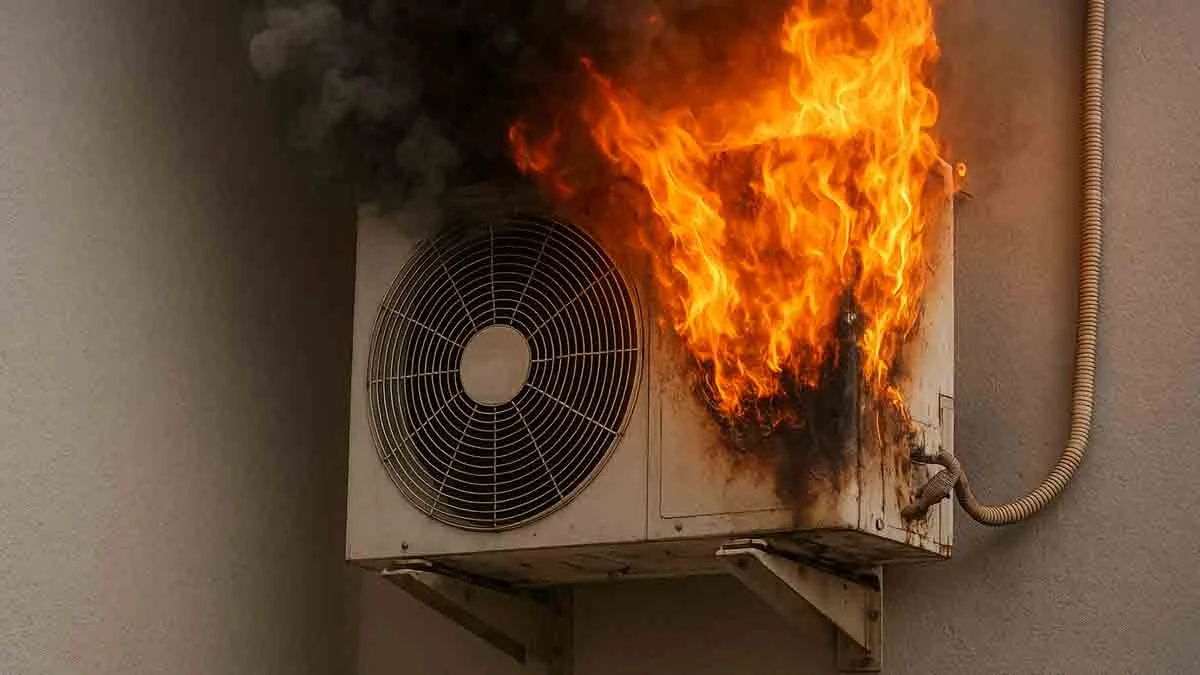
reasons for ac blast
AC Blast In Delhi kills 9 People, Find Out Why Your AC Turns Into A Ball Of Fire : A horrific accident in Vivek Vihar, Delhi, shook the entire city early Sunday morning. A fire in a four-story residential building claimed the lives of nine people, injuring several others. Initial investigations have identified an AC blast as the primary cause. Following the AC blast, the fire spread so rapidly that it engulfed the second, third, and fourth floors, preventing residents from escaping. This incident has once again raised serious questions about the safety of ACs installed in homes. Here, we explain the factors that can lead to a fire or explosion.
Most common causes of AC fire
According to experts, there are many reasons behind AC fires. The most common causes are short circuits, overloading, and faulty wiring. Running an AC continuously for extended periods increases the pressure on its compressor, which can lead to a spark or explosion. Failure to have timely service, poor wiring, or the use of locally manufactured parts also increase the risk. In many cases, voltage fluctuations can also cause a fire inside the AC.
Which components of the AC are at risk of fire?
- Most of the fires in AC occur in the compressor unit, because it gets heated the most while working continuously.
- If the capacitor inside the outdoor unit malfunctions, there is a risk of sparks and explosions.
- PCB i.e. Printed Circuit Board can burn immediately due to short circuit.
- Loose wiring and connections to the indoor unit can cause sparks.
- The power cables and terminals connected to the compressor often overheat and catch fire.
- Due to dust accumulation in the fan motor or the motor getting jammed, it may heat up and burn.
- Leaks and sparks around refrigerant pipes can cause fires to spread rapidly.
- Faulty relays, contactors or circuit breakers are also common causes of AC fires.
Take these precautions while using AC
Regular servicing is essential for safe AC operation. Always use high-quality wiring and have it installed by an authorized technician. A separate power line and an MCB of the correct capacity should be installed for the AC. Avoid running the AC continuously for extended periods of time and don’t ignore any unusual noises, smells, or sparks. Addressing minor problems early can prevent major accidents. It’s crucial to be cautious when using your AC during the summer.
These are the reasons why your AC can become a ball of fire.
- Avoid running your AC continuously for more than 6 to 8 hours. If running for longer periods, it’s best to take a 15-30 minute break in between to allow the compressor to cool down.
- If the outside temperature is very high, run the AC at 24 to 26 degrees Celsius. Running at very low temperatures puts extra strain on the machine.
- Clean your AC filters every 15 days. Dirty filters block airflow, which can cause the AC to overheat.
- Get professional servicing done at least twice a year. It’s best to get it done before the start of summer.
- Install a separate power socket for the AC and an MCB of the correct capacity. Avoid using extension boards.
- If you notice any burning smell, sparks, unusual noise or water dripping from the AC, turn it off immediately.
- Using a stabilizer is essential in areas with voltage fluctuations. This protects the AC from sudden high or low voltage surges.
- Always have an authorized technician install it. Improper fittings, loose wiring, or faulty parts can cause serious accidents in the future.
ALSO READ : Does A Life Jacket Really Save Your Life When Drowning? How Safe Is It, And When Is It Not?