

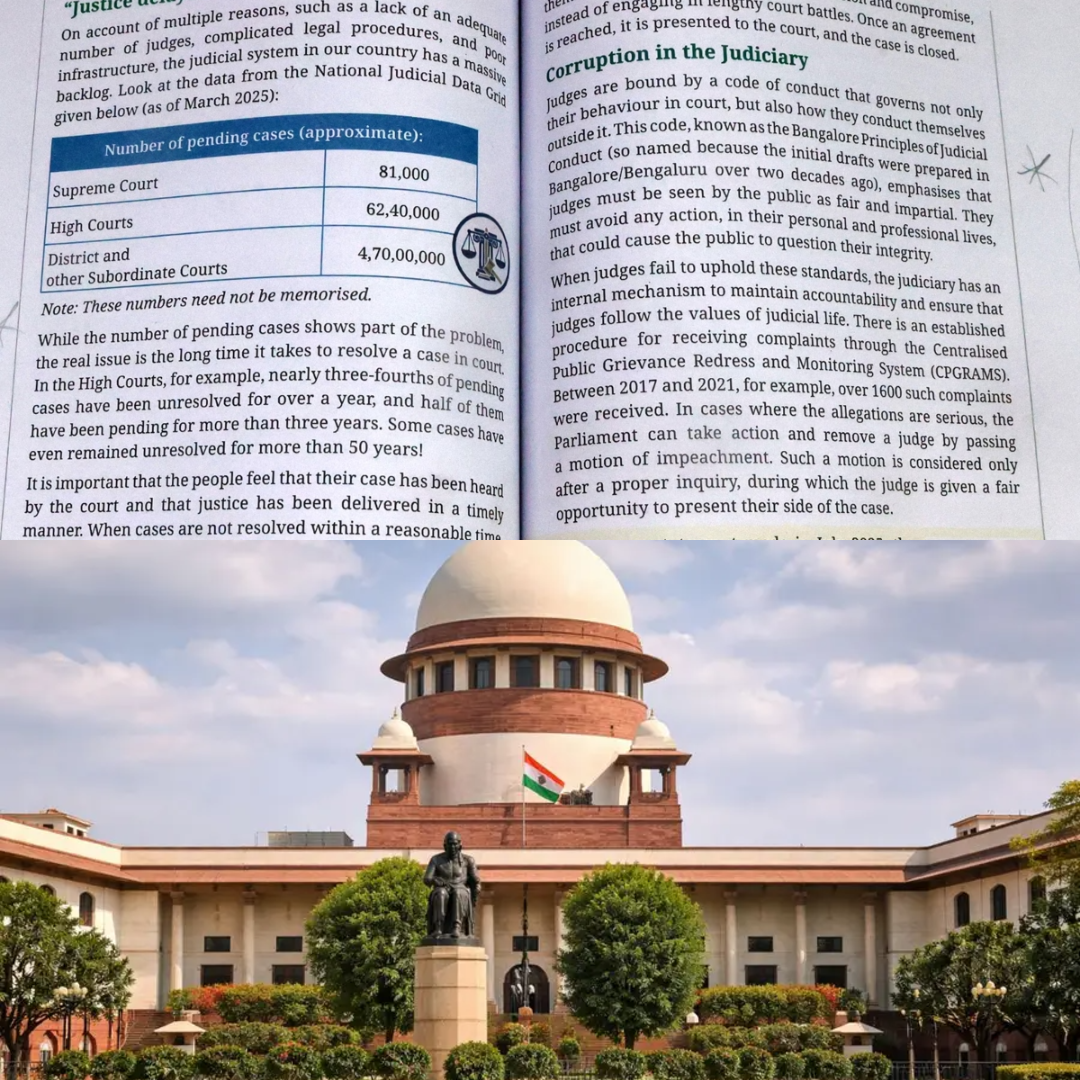
Supreme Court Flags Concern, NCERT to Remove Judiciary Corruption Section from Class 8 Textbook
Government to Remove ‘Corruption in Judiciary’ Section from Class 8 NCERT Textbook After Supreme Court Concern: A section discussing “corruption in the judiciary” in a new Class 8 Social Science textbook published by National Council of Educational Research and Training (NCERT) will be removed following objections from top authorities and concerns raised in the Supreme Court.
According to senior government sources, the inclusion of such content in a textbook meant for young students was considered inappropriate. Officials said educational material for children should be more constructive and inspiring, rather than focusing on sensitive institutional issues.
The controversy intensified after references were made to remarks by former Chief Justice B. R. Gavai. Sources indicated that quoting his statement in this context was seen as unsuitable. It was also reported that the current Chief Justice expressed displeasure over the content.
During the hearing, Chief Justice Surya Kant strongly objected to what he described as attempts to defame the judiciary. He stated that the court would not allow the institution’s dignity to be undermined and observed that suo motu cognizance could be taken if necessary. The Supreme Court remarked that the reference had caused concern among members of the judiciary, particularly High Court judges.
The issue was brought before the court by senior advocate Kapil Sibal, who argued that teaching Class 8 students specifically about corruption in the judiciary was troubling. He questioned why similar references were not made regarding corruption in other institutions. Senior advocate Abhishek Manu Singhvi also raised concerns about what he termed a selective approach. Justice Joymala Bagchi observed that parts of the content appeared to run contrary to the doctrine of the Constitution’s basic structure.
What Did the Book Contain?
The textbook, titled “The Role of the Judiciary in Our Society,” discussed challenges facing India’s judicial system. It mentioned the large number of pending cases — approximately 81,000 in the Supreme Court, around 6.24 million in High Courts, and nearly 47 million in district and subordinate courts.
The book also noted that judges are bound by a code of conduct and highlighted grievance redressal mechanisms such as CPGRAMS. It referred to steps taken to improve transparency and the use of technology within the judiciary.
A disputed section quoted a July 2025 statement by former Chief Justice B.R. Gavai, where he acknowledged that incidents of corruption and misconduct could impact public trust, but emphasized that confidence could be restored through transparent and prompt action.
Section to Be Withdrawn
For now, the government has indicated that the contentious portion will be removed from the textbook. The Supreme Court has made it clear that while discussions on institutional reforms are important, the dignity and prestige of the judiciary must remain protected.
The development has sparked a broader debate about how complex constitutional institutions should be presented to young students — balancing awareness with responsibility.
ALSO READ: Rajinikanth film Coolie Famous Dialogue