

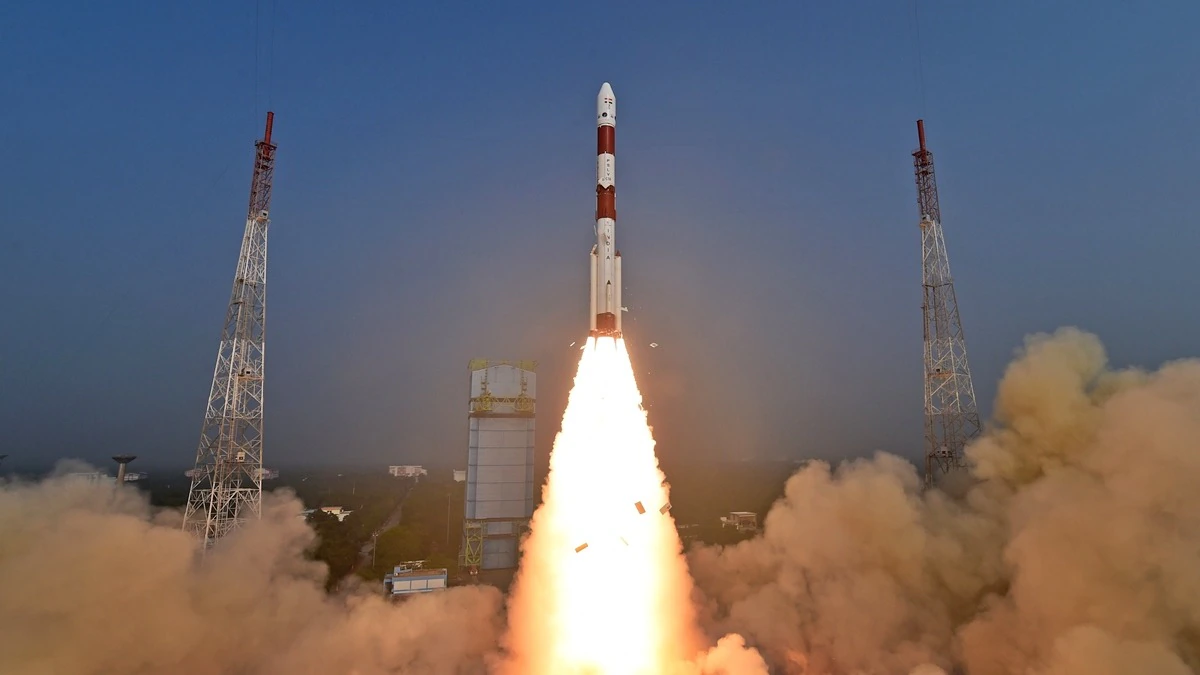
ISRO’s PSLV-C62 Launch Successful, but Satellite Deployment Fails; Analysis Underway
ISRO’s PSLV-C62 Faces Failure After Anwesha Course Change: The Indian Space Research Organisation (ISRO) on Monday successfully launched the PSLV-C62 rocket, known as India’s “divine vision,” from the Satish Dhawan Space Centre (SDSC), Sriharikota, at 10:17 a.m. This marked the first orbital mission of 2026 and the 64th flight of PSLV. However, despite a successful launch, the mission faced a setback as the satellite could not be deployed.
ISRO said the mission encountered an abnormal condition at the end of the PS3 stage, following which a detailed analysis has been initiated. If the mission had been completed as planned, India would have become the second country in the world, after China, to achieve satellite refueling technology in space—a milestone yet to be achieved by the United States and Europe.
14 Satellites Launched by NSIL
Along with PSLV-C62, 14 additional satellites were launched by NewSpace India Limited (NSIL). The mission was aimed at placing satellites into a Sun-Synchronous Orbit (SSO). A key payload was the Earth Observation Satellite EOS-N1 (Anvesha), which was intended to be positioned in a polar SSO at an altitude of around 600 kilometers. The entire mission was live-streamed on ISRO’s YouTube channel.
The PSLV-C62 rocket was developed using a combination of technologies from Thailand and the United Kingdom.
Focus on Space Refueling Technology
A major highlight of the mission was the AULSAT satellite developed by Bengaluru-based startup OrbitAid. Weighing 25 kilograms, AULSAT was scheduled to carry out its first in-space internal refueling experiment within four hours of launch. The technology is expected to play a crucial role in the future by enabling fuel transfer between spacecraft, extending satellite life and reducing mission costs.
Worship Before Launch
Continuing ISRO’s long-standing tradition, ISRO Chairman V. Narayanan offered prayers at the Tirupati temple ahead of the launch. After a failed PSLV mission in May last year, today’s launch was viewed as an important comeback attempt for the space agency.
Why Anvesha Satellite Is Special
The Anvesha (EOS-N1) satellite is a highly advanced spy satellite designed to strengthen India’s security capabilities. Equipped with hyperspectral remote sensing (HRS) technology, it can detect a wide range of light wavelengths and identify objects based on subtle color and brightness differences. Anvesha is capable of capturing high-resolution images of targets from hundreds of kilometers above Earth, making it a valuable asset for surveillance and national security.
Despite the deployment issue, ISRO officials said lessons from the mission would help refine future launches, as the agency continues to push the boundaries of advanced space technologies.
ALSO READ: Side Effects Of Consumption Tulsi