

New UGC Rules 2026
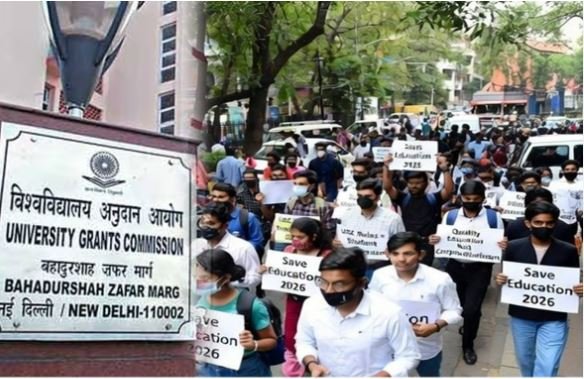
What Is New UGC Rules 2026 : The government announced new UGC regulations to curb caste-based discrimination faced by students from reserved categories in universities. As per the rules, all Higher Education Institutions (HEIs) must form a committee on campus to address complaints related to caste discrimination and ensure equity across the institution. However, this move triggered protests from upper caste or General category students, who argued that no separate provisions have been made for them. Protesters at the UGC headquarters also alleged that the regulations could lead to an increase in complaints from reserved category students. The regulations and the protests against them have drawn responses from both the government. The All India Student Association (AISA) has also issued a statement on the same.

What Is Ugc
The University Grants Commission (UGC) is a statutory body responsible for the coordination, funding, and maintenance of standards in higher education in India. It was established to ensure uniform quality and systematic development of universities across the country.
The idea of a national higher education system originated from the Sargeant Report, 1944.
A University Grants Committee was formed in 1945 to supervise Aligarh, Banaras, and Delhi universities.
By 1947, its jurisdiction was extended to all existing universities in India.
The University Education Commission (1948) chaired by Dr. S. Radhakrishnan recommended restructuring it on the British model.
In 1952. the Union Government designated the University Grants Commission to oversee grants for higher education institutions.
The UGC was formally inaugurated in 1953 by Maulana Abul Kalam Azad.
It became a statutory body in 1956 under the UGC Act, 1956.
The UGC is headquartered in New Delhi.
It consists of a Chairman, Vice-Chairman, and ten members appointed by the Central Government.
Its main functions include grant allocation, advising on higher education reforms, and maintaining academic standards.
University Grants Commission (Promotion of Equity in Higher Education Institutions) Regulations, 2026 Provisions
Comprehensive Coverage of Caste-Based Discrimination: The regulations clearly define caste-based discrimination to include unfair or biased treatment against Scheduled Castes (SCs). Scheduled Tribes (STs), and Other Backward Classes (OBCs). This explicitly extends legal protection to OBCs and addresses a major gap in earlier policy frameworks.
Expanded and Inclusive Definition of Discrimination: Discrimination is broadly defined as any unfair, biased, or differential treatment, whether direct or indirect, based on caste, religion, race, gender, place of birth, or disability. It also includes actions that undermine equality in education or violate human dignity.
Mandatory Establishment of Equal Opportunity Centres (EOCs): All higher education institutions are required to establish an Equal Opportunity Centre (EOC) to promote equity, social inclusion, and equal access, and to handle complaints related to discrimination on campus.
Formation of Equity Committees under EOCs: Each institution must constitute an Equity Committee under the EOC, chaired by the head of the institution, with compulsory representation from SCs, STS, OBCs, women, and persons with disabilities. ensuring inclusive and balanced decision-making.
Reporting and Compliance Framework: Equal Opportunity
Centres must submit bi-annual reports, and institutions are required to file an annual report on equity-related measures with the UGC, strengthening transparency and institutional accountability
Institutional Responsibility and Leadership Accountability: The regulations place a clear obligation on institutions to eliminate discomination and promote equity, with the head of the institution held directly responsible for effective implementation and compliance.
National-Level: Monitoring Mechanism: The UGC will set up a
national monitoring committee comprising representatives from statutory bodies and civil society to oversee implementation, review complaints, and recommend preventive measures. The committee will meet at least twice a year.
Strict Penalties for Non-Compliance. Institutions that violate the regulations may face debarment from UGC schemes restrictions on offering degree, distance, or online programmes or withdrawal of UGC recognition, making the regulations legally enforceable rather than merely advisory.
Why Are There Protests Against UGC’s Equity Regulations?
The protests are being led by the “Savarna Sena” outside the UGC headquarters. Shivam Singh, co-founder of the “Savarna Sena,” said the group will call off the protests if the government assures that general category students will not be adversely affected.
The protests are mainly due to the following reasons:
• The protestors at the UGC headquarters have alleged that General category students or others, apart from reserved category candidates, can not raise their complaints, as no clear provision exists for them in the new regulations.
• They also claimed that the regulations may increase inequality instead of promoting equality, as they believe complaints from reserved categories could rise.
• The data shows that complaints related to caste discrimination in universities were around 173 during 2016-2017, but rose to over 350 in the 2023-2024 academic year, suggesting a rise in such cases.
ALSO READ : India Post GDS Bharti 2026: 28,740 GDS Vacancies In India Post , See State Wise Post Details Here